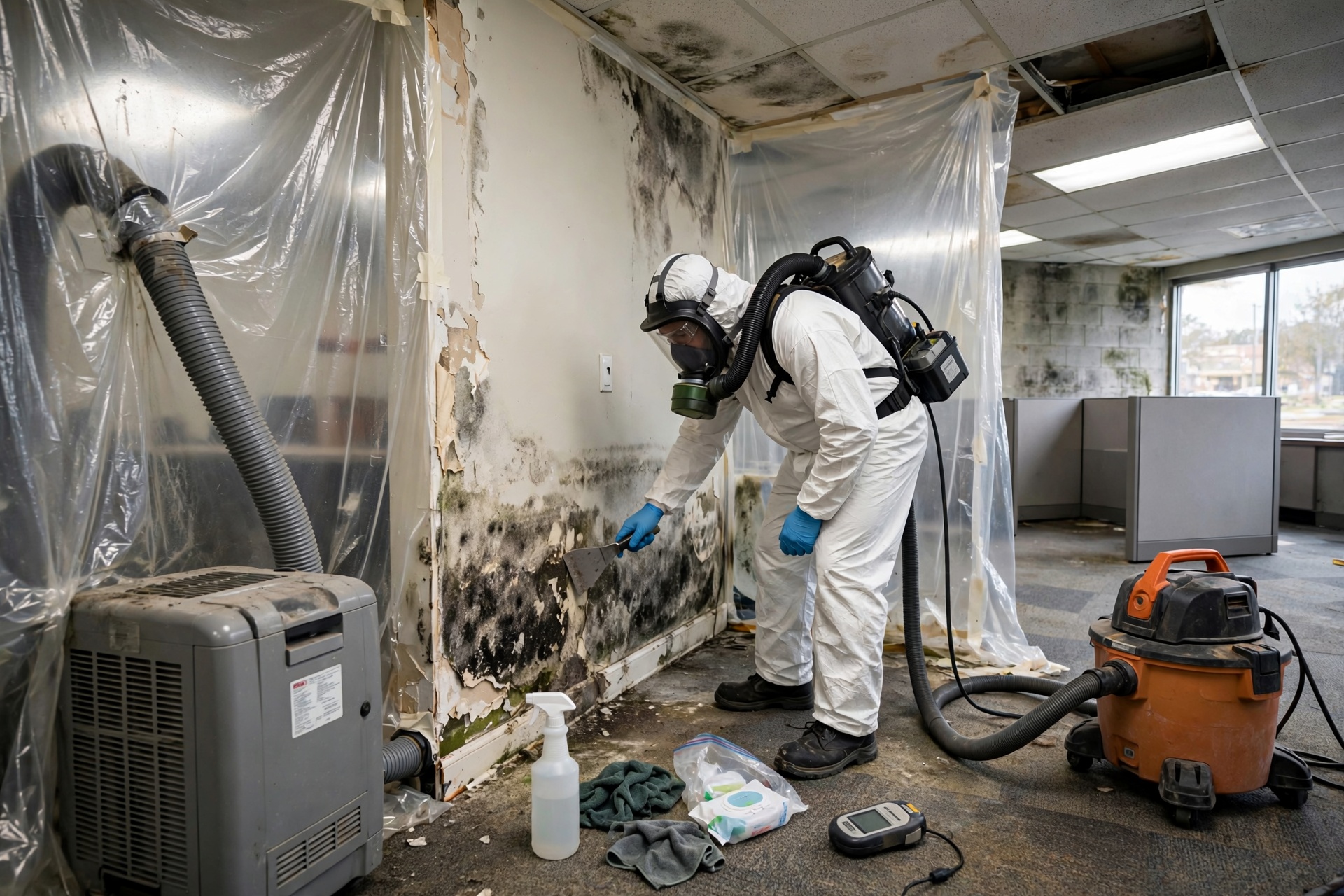
Commercial properties in Channelview often sit close to the San Jacinto River, where repeated high-water events and constant humidity push moisture into slab foundations and wall cavities of older warehouse and retail buildings. HVAC systems in these structures frequently recirculate spores when coils stay damp, turning small leaks into widespread contamination across drop ceilings and insulation. Remediation crews must isolate zones with negative air machines while protecting active business operations, because shutting down an entire facility is rarely an option.
Harris County commercial stock from the 1970s and 1980s commonly uses porous CMU block and metal decking that traps water after hurricanes or heavy rains. Removing visible growth without addressing the hidden moisture behind these materials leads to rapid regrowth once the building returns to normal humidity levels. Technicians map moisture with infrared cameras and pin meters, then remove affected drywall, baseboards, and insulation in controlled sections so the rest of the space can stay open.
After source removal, commercial jobs require targeted air scrubbing and dehumidification sized for the square footage and ceiling height typical of Channelview warehouses. Post-remediation clearance sampling confirms spore levels match outdoor baselines before any new finishes are installed. This step prevents callbacks when summer humidity spikes again or when the next tropical system pushes more water through the same low-lying lots near Channelview Park.
Technician insight
In Channelview the thing that catches most people out with commercial mold remediation is how the San Jacinto River keeps the water table high under slab foundations. Even after a small roof leak, humidity from the soil keeps the concrete damp for weeks, so crews have to pull base plates and run drying equipment longer than the same job in drier parts of Harris County.
Cloverleaf warehouse after heavy rains
A distribution warehouse near the river developed black growth along the east wall after three days of standing water. Infrared scans showed moisture trapped behind metal siding and in the insulation. Crews isolated the bay, removed the wet materials, and ran dehumidifiers until clearance samples passed. The rest of the facility stayed open for shipping.
Commercial Mold Remediation Services We Offer
✓Warehouse Mold Containment
Install negative-pressure barriers and air scrubbers to isolate mold in active warehouse bays without halting shipping operations.
✓Office HVAC Coil Cleaning
Remove mold from commercial rooftop units and ductwork that recirculates spores through multi-tenant buildings in Cloverleaf.
✓Retail Space Drywall Removal
Cut out and dispose of moisture-damaged drywall and insulation behind display walls after roof leaks or flooding near the river.
✓Post-Hurricane Commercial Assessment
Document hidden moisture in slab edges and wall cavities of retail and light-industrial buildings following tropical storms.
✓Tenant Space Odor Neutralization
Apply EPA-registered antimicrobials and run hydroxyl generators to eliminate musty odors in leased spaces without strong chemical smells.
Commercial Mold Remediation Cost in Channelview, TX
| Service | Typical Range | What Affects It |
|---|---|---|
| Small retail suite assessment and containment | $1,800–$3,200 | Size and number of affected rooms drive cost. |
| Warehouse bay mold removal | $4,500–$9,000 | Ceiling height and HVAC access increase scope. |
| Post-flood commercial drying and sampling | $2,200–$4,800 | Number of moisture meters and dehumidifier days. |
Ranges are typical for Channelview, TX and confirmed with an exact written quote before any work starts.
How it works
- 1
Initial Site Walk
Technicians inspect affected commercial spaces, note HVAC layouts, and identify moisture sources tied to river proximity or roof penetrations.
- 2
Containment Setup
Plastic barriers and negative air machines isolate work zones so daily business traffic can continue in unaffected areas.
- 3
Material Removal
Remove and bag moldy drywall, insulation, and ceiling tiles while HEPA vacuuming surfaces to prevent cross-contamination.
- 4
Drying and Clearance
Run commercial dehumidifiers, then collect air samples to confirm spore counts meet outdoor baselines before reopening.
Pricing
Commercial pricing scales with square footage, HVAC complexity, and whether work occurs during business hours or after hours.